
In short:
- In Paris, the main obstacle to a seminar is not budget but the difficulty of finding one venue that hosts the plenary, the activity and the meal.
- The closing activity answers a precise need, releasing pressure after a day spent sitting. Short, physical formats work better than thinking exercises at that hour.
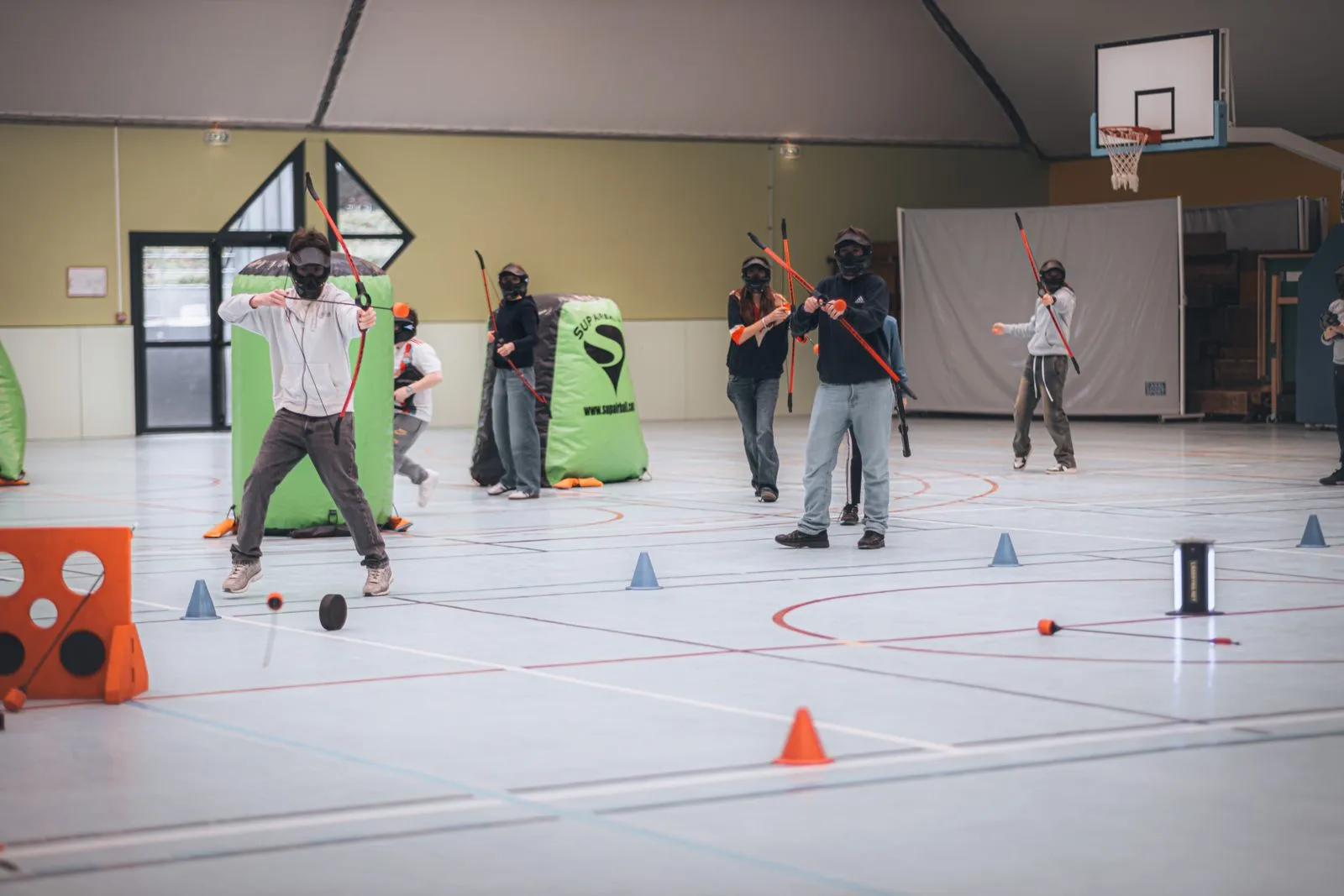
- Rotating venues such as the Bomb Squad action game absorb up to 30 players over a two-hour slot (50 participants on site), which solves mid-size headcounts without a buyout.
- Venues combining an activity and catering, such as PAN Bar, let a speech, an activity and dinner run without moving the group.
The three possible set-ups in Paris
| Set-up | Suitable headcount | Advantage | Constraint |
|---|---|---|---|
| Single venue, plenary plus activity | up to 50 | No travel, smooth day | Rare offer within Paris |
| Meeting room plus nearby activity venue | 20 to 100 | Full freedom of choice | One transfer to organise |
| Full off-site day | 30 and up | Strong break effect | Transport, budget and logistics |
The second set-up remains the most common, because it lets you choose the quality of the room and of the activity separately. The deciding criterion then becomes the distance between the two, as a transfer of more than twenty minutes breaks the momentum of the day. For the activity, the comparison of venues to organise a team building in Paris sorts the options by team size.
Sequencing the day
The structure that works best follows the group’s energy rather than the ideal agenda.
- Morning: the substantive topics, strategy, decisions. It is the only window where attention is genuinely available.
- Lunch: do not cut it short, this is where the informal exchanges a seminar is meant to trigger actually happen.
- Early afternoon: small-group workshops, never a top-down plenary, the post-lunch dip is real.
- End of day: the cohesion activity, then a social moment.
The most frequent mistake is placing the activity right after lunch to “wake the group up”. In practice it burns the little energy left, and the afternoon of work that follows is lost.
Choosing the closing activity
After a day sitting down, the goal is not to make people think but to make them move. Two families of format answer that need.
Rotating physical formats
Bomb Squad Paris, on boulevard de Sébastopol in the 3rd, runs teams of 2 to 6 players with a start every ten minutes, which lets up to 30 players go through over a two-hour slot (50 participants on site). Each team runs four ten-minute challenges, a laser corridor, a room fully covered in light-up tiles, a sound memory test and a communication challenge, before trying to defuse a paint bomb.
Pricing is degressive, from 48 euros per player for two down to 30 euros for six, and the 80 sqm reception area with a bar lets waiting teams hold and the group debrief afterwards. Quotes are promised within 24 hours. Bomb Squad Paris offers a dynamic activity that releases the group’s energy, with comfortable clothing recommended.
Convivial formats with catering
When the seminar ends with dinner, the activity and the meal may as well happen in the same place. PAN Bar, on rue de Paradis in the 10th, offers private virtual shooting booths with homemade cooking and a cocktail list. The corporate package starts at 36 euros per person with one drink and one dish for every four. From 30 people, a buyout opens the venue’s 400 sqm, with a dedicated host and the option to screen a presentation, which allows the seminar to close on a speech before shifting into the evening.
What makes a seminar fail
Three causes recur, and none of them is budget.
Too dense a day. Stacking plenary, workshops, activity and dinner with no breathing room produces an exhausted group that retains nothing. Better to drop an agenda item than to add a slot.
An activity that excludes. Any format that assumes physical fitness, ease with public speaking or shared cultural references leaves part of the team behind. That is the opposite of the stated goal. Checking venue accessibility belongs to the same reflex.
No follow-up. A seminar produces decisions and commitments. Without minutes and a follow-up in the weeks after, the effect fades within a fortnight and the exercise reduces to an expense.
The checklist before booking
- Confirm the real headcount, not the invited headcount.
- Check the distance between the meeting room and the activity venue. The business centres listed in our comparison of offices for rent in Paris 8th rent meeting rooms near Gare Saint-Lazare.
- Settle catering, it is the line that will move the final budget.
- Ask in writing about accessibility and how physical the activity is.
- Book early from September to December, the period when weekday evening slots go first.